Harger: He’s accused of stealing $1,000 in copper off the West Seattle Bridge. Ratepayers got a $100,000 bill. He didn’t show up to court
Jul 10, 2026, 7:05 AM | Updated: 7:10 am
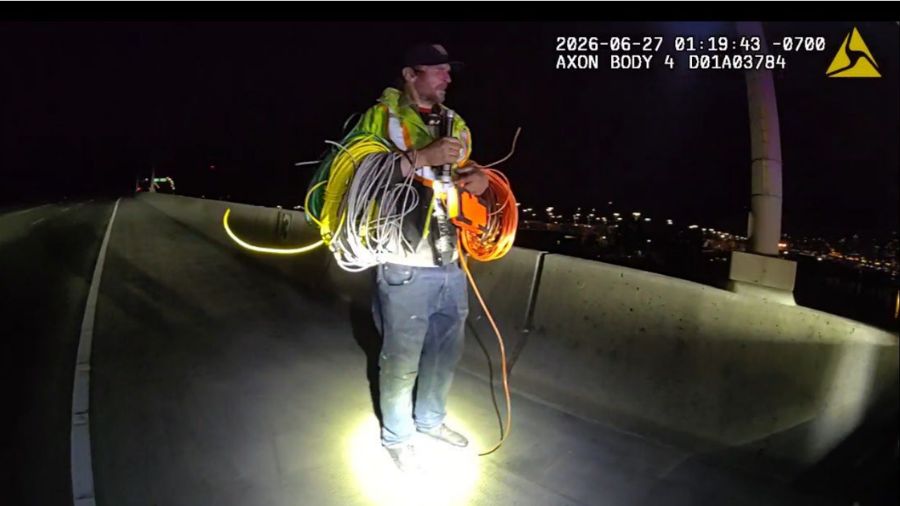
A photo of 47-year-old Gregory Wayne Galitzeck stopped by police with bundles of wire hanging from his arms. (Photo courtesy of Seattle Police Department)
(Photo courtesy of Seattle Police Department)
At 1:19 in the morning on June 27, according to the police report, a Seattle police officer on routine patrol spotted a man walking along the shoulder of the westbound lanes of the West Seattle Bridge. The bridge is a limited-access freeway. Pedestrians aren’t allowed up there. It’s illegal, and at that hour, it’s a good way to get killed.
What followed was a single case that touches every problem we’ve been covering. Copper wire theft off critical infrastructure. A revolving-door justice system with lenient release rules that let a man with 16 warrants walk out on a promise. Homelessness. Drug addiction. And somewhere at the end of the chain, recyclers are paying cash for wire that no honest person came by honestly.
One man. One bridge. One night. Every broken piece, all at once.
The officer stopped 47-year-old Gregory Wayne Galitzeck. Per the report, he had bundles of wire hanging from his arms, a flashlight in one hand, and a tool case in the other. When asked what he was doing up there, Galitzeck said he was working for Seattle City Light.
The officer didn’t buy it. No city ID. No city vehicles. No other workers. No lane closures. In the officer’s experience, city crews show up with multiple trucks and shut down at least one lane. Galitzeck showed up alone, on foot, in the dark.
A frisk turned up two pairs of wire cutters, one heavy-duty, according to the report.
Dispatch checked with City Light. They had no workers on the bridge. At the precinct, after being read his rights, police said Galitzeck kept insisting he was a city worker.
He wasn’t one, though. Investigators said City Light’s security manager confirmed Galitzeck has never worked there.
West Seattle Bridge copper wire theft: $1,000 in wire, $100,000 in damage
According to the charging documents, a City Light streetlight engineering supervisor reviewed the officer’s bodycam photo and estimated Galitzeck was carrying four 100-foot coils of wire. Scrap copper fetches about $5 a pound.
Value of the wire: about $1,000.
Cost to set up traffic control on the bridge, assess the streetlights, and repair the damage: about $100,000.
A hundred-to-one ratio. A thousand bucks of loot, and City Light ratepayers get a six-figure bill.
The same supervisor told investigators that copper theft from West Seattle Bridge streetlamps is an ongoing problem, and some of these lights were already dark before Galitzeck allegedly showed up with his wire cutters. Those aren’t my words. They’re from Seattle City Light’s own engineering supervisor, according to the charging documents.
The West Seattle Bridge has become a self-service copper supply depot for thieves, and everyone knows it. Even the fake city worker routine is a rerun. The SPD investigator on this case noted he’d handled another copper case earlier this year with the exact same disguise.
Released without bail despite 16 warrants and an escape conviction
Galitzeck was charged with three first-degree felonies: malicious mischief, criminal impersonation, and theft. Serious charges, appropriately filed.
Then comes the part of the court file that tells you everything about the system’s default settings. The state’s filing requested a summons for Galitzeck to appear, with conditions: keep his address current, show up to all hearings, commit no new crimes, and have no contact with the West Seattle Bridge.
That’s right. The plan for protecting a piece of critical infrastructure from a man allegedly caught on it at 1 a.m. with wire cutters was to ask him nicely to stay away from the bridge.
As The West Seattle Blog reported, the King County Prosecuting Attorney’s Office warned the court that Galitzeck had 16 prior arrest warrants and was unlikely to appear for arraignment.
The court let him go on his own promise to come back. No bail. No ankle monitor. Just his word.
A spokesperson for the prosecutor’s office offered some context on why that happens. Under Washington’s Criminal Rules 2.2 and 3.2, which the state Supreme Court sets, a judge may hold a defendant on bail only if they pose a risk of committing a violent offense or of flight. Even if the prosecutor, the defense attorney, and the judge all agree the defendant is likely to walk out and commit another nonviolent property crime, the rules say that alone isn’t enough to keep them in custody.
Everyone in the courtroom can see what’s coming. The rules say: let him go.
Which makes this case even harder to explain. Galitzeck has an escape conviction and 16 prior warrants. Under those same court rules, that is a textbook flight risk. And he still walked out.
Now look at what everyone involved could see in his file, as laid out by prosecutors. Two burglary convictions. A 2018 conviction for escape means he has a documented history of not staying where the system puts him. A conviction for making a false statement, meaning he has a documented history of lying to authorities, the same thing police said he was doing on the bridge and kept doing after his Miranda rights. A 2016 meth delivery conviction. Sixteen warrants for his arrest since 2008.
His listed address on the arrest form is a homeless services drop-in center in Pioneer Square. It’s a mail stop, not a residence. There is no home to go home to.
A promise to appear from a man whose file has a 16-warrant history of not appearing.
He didn’t. On Tuesday morning, Galitzeck failed to appear for his arraignment. He’s not in custody. King County Superior Court Judge Nelson Lee issued the bench warrant, Galitzeck’s 17th, and set bail at $5,050. That works out to about 5% of the repair bill his alleged crime stuck ratepayers with.
Anyone shocked hasn’t been paying attention.
RELATED STORIES


King County copper recyclers and the bill Olympia let die
As senior deputy prosecuting attorney Gary Ernsdorff told me earlier this year, the problem runs past the thieves to the market that buys what they steal.
“My dad’s 97 years old,” Ernsdorff said. “He can’t see well enough to drive. He can’t hear very well. But if a dude came up to him in a ratty old pickup truck with a pair of bolt cutters and a whole bunch of four-foot sections of communication copper wire transmission line, he could spot a thief a mile away.”
So let’s talk about one of those recyclers. I’m not naming any specific businesses. But I always encourage listeners to send me pictures of what they see, and they do. My audience pays attention. They send me photographs of abandoned shopping carts piled with stripped wire insulation sitting right outside the property line of a nearby recycler. Just sitting there. In the open. Stripped insulation and shopping carts, in a neat little pile, feet from the front gate. And we’re supposed to believe the people buying copper on the other side of that fence have no idea where it’s coming from.
If you’re a business looking the other way on where your copper comes from, understand something. People in this community see it. They photograph it. And they send it to me.
The King County Sheriff’s Office handled 241 copper theft cases in 2025 alone. Those are just the ones that got reported. The actual number is higher, and everybody in the industry knows it.
There was a fix on the table in Olympia this year, with support in both chambers. King County Prosecuting Attorney Leesa Manion worked with Rep. Cindy Ryu on HB 2213 in the House and Sen. Tina Orwall on SB 6190 in the Senate. Both bills would have required recyclers to photograph copper purchases, upload them to a searchable statewide database, and hold materials long enough for police to investigate, with stolen material subject to seizure. As a spokesperson for the prosecutor’s office told me this week, the bills “would have significantly improved law enforcement’s ability to track down wire thieves” and would dissuade recyclers “from purchasing suspicious items knowing that law enforcement will be reviewing it and that it is subject to seizure.”
Neither bill passed. The legislature ended the session in March without voting on either one.
The prosecutor’s office said it isn’t waiting. This summer, King County prosecutors have already met with Sound Transit, the Attorney General’s Office, and lawmakers, all of whom have expressed support for taking action in the 2027 session.
We’ve run this play before. The catalytic converter bill took about three years to pass while everybody’s Prius got gutted in the driveway. When it finally did, the market dried up and the thefts all but vanished. Take away the buyer, and the crime stops paying.
Nobody punished him. Nobody helped him either
Gregory Galitzeck is a 47-year-old man with a meth conviction, no stable housing, and nearly two decades of cycling through the system. At 1:19 in the morning, police said, he was alone on a freeway bridge with wire cutters, pretending to be someone he’s not, for a thousand dollars’ worth of copper.
After all these convictions, after the escape, after 16 warrants, the answer can’t be “go home and promise to come back.” Most of the developed world figured this out a long time ago. When someone is this deep in the cycle, the choice is jail or treatment. Either one means a roof, a bed, and time away from whatever substance is running the show. We picked neither.
That traffic stop was a moment to intervene in a human being’s life. Get him into treatment. Connect him to a support system. Hold him somewhere long enough for either to take. Out of common sense as much as compassion, because the alternative is the loop we’re funding now: release, no-show, warrant, wait, repeat.
We’re not holding him accountable. We’re not getting him help. We’re doing nothing and calling it a system.
Tonight, stretches of the West Seattle Bridge are still dark. Somewhere out there, so is Gregory Galitzeck. We didn’t hold him. We didn’t help him. We just let him walk.
Charlie Harger is the host of “Seattle’s Morning News” on KIRO Newsradio. You can read more of his stories and commentaries here. Follow Charlie on X and email him here.