SEATTLE NEWS ARCHIVES & FEATURES
Transportation analyst says congestion pricing devastates the poor
May 31, 2019, 2:54 PM
(Michael Simeona)
(Michael Simeona)
According to Mariya Frost, director of the Washington Policy Center’s Coles Center for Transportation, the City of Seattle’s congestion pricing plan will bring financial heartache for one group specifically — low-income residents.
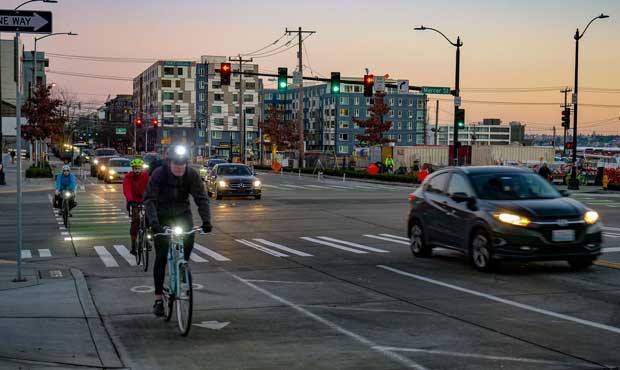
As outlined in a preliminary report, the city is looking at implementing a congestion pricing program — charging drivers every time they drive into downtown Seattle — to reduce carbon emissions and encourage public transit use, biking, and walking.
Other cities around the world, such as London, Stockholm, and Milan, have congestion pricing systems, but unlike Seattle, these are cities with more than one metro line running through them. The other North American cities currently considering a congestion pricing plan — New York City, San Francisco, and Vancouver — also have fully developed subway and light rail systems with multiple lines.
Besides the Seattle Department of Transportation, the Puget Sound Regional Council and Sound Transit have also looked into or expressed their support for charging drivers based on how much they drive. Last year, the state conducted a road usage charge pilot program to test how well a system of charging drivers per mile traveled would work.
Could pay-per-mile road usage charge lead to state automating speeding tickets?
Supporters of congestion pricing and road usage charges hail these as a quasi-socialist policies that take money from wealthier classes and transfer it to areas that benefit the poor, such as public transportation projects.
But for Frost, who was born in what was then the U.S.S.R., that argument sets off alarm bells.
“My family and I immigrated here from Russia to get away from this system, and I cannot even believe that we are having this conversation in America, trying to explain to people why socialism is not a moral good, why taking hard-earned wealth from one group of people and redistributing it to another group is theft,” she said to KIRO Radio’s Dori Monson.
She looks at not just the transfer of wealth through taxation as a socialist policy, but also at the transfer of transportation methods, such as taking travel lanes from drivers and giving them to cyclists.
Congestion pricing is devastating for those who cannot afford to live in central Seattle and must commute to work from 30 miles away every day, Frost said.
“By talking so favorably about what are effectively socialist policies, and leveraging road usage charge money in this way, it tells me that public officials are completely out of touch with how most of the region lives and travels, and what they value, which is personal freedom,” she said.
With Seattle’s affordable housing shortage at an all-time high, Frost said that she and her family find it challenging to afford to live near Tacoma, let alone Seattle. It’s hypocritical, she said, to kick the people forced out of Seattle when they’re already down.
“Sound Transit and the Puget Sound Regional Council and all these other folks claim to care about the poor, when in fact their policies and their projects have a [disproportionate] impact on the poor,” she said. “They’re displacing the poor and making it impossible for the rest of us to be able to afford anywhere near our places of work.”
In its report, SDOT acknowledged the detrimental effect that congestion pricing could have on people with lower incomes. The city promised to use community engagement to hear those residents’ voices and create a fair pricing system.
Other cities’ experiences have demonstrated that there can be unintended consequences to congestion pricing. Without a clear focus on social and racial equity, pricing can burden low income people with new costs, just when skyrocketing housing costs are forcing many to move to the suburbs where driving may be the only option for most trips.
Ideas mentioned in the report included providing low-income residents with free or discounted transponders, as well as toll discounts or credits.
However, congestion pricing is not the only way in which transportation departments hurt the poor and working classes, Frost said — she pointed to WSDOT’s toll lanes on I-405 as another punishment for commuters.
In order to remain past their initial trial period, the I-405 toll lanes were originally supposed to fulfill the goals of paying for themselves and operating at a minimum speed of 45 miles per hour 90 percent of the time. As Frost explained earlier this year, the toll lanes have met the payment requirement, but only hit 45 miles per hour 81 percent of the time.
However, a bill passed this session in the Legislature amended the language so that the toll lanes only needed to meet one of the requirements.
The tolls are “another punitive tax on drivers that we are going to have to pay with no real accountability, no improvement to our commute, because the promise for an improved commute was completely gutted,” she said.