Washington State Senate passes pair of landmark climate change bills
Apr 9, 2021, 3:30 PM
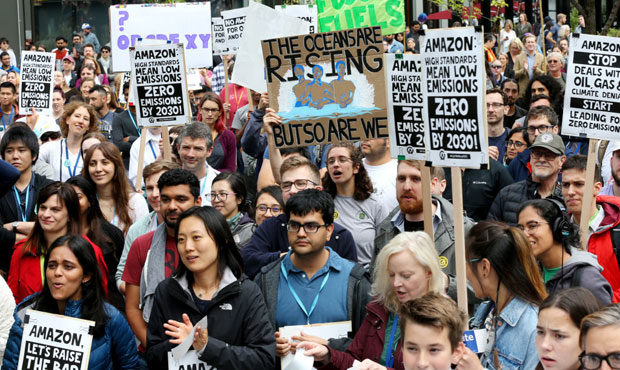
Amazon and other tech employees participate in the Global Climate Strike on September 20, 2019. (Photo by Karen Ducey/Getty Images)
(Photo by Karen Ducey/Getty Images)
The hour was late Thursday evening, but the Washington State Senate still passed two pieces of climate change legislation proposed by Governor Inslee — the clean fuel standard and the Climate Commitment Act, also known as the cap-and-invest bill.
The past two years in a row, the clean fuel standard passed the House and then failed in the Senate. But, the third time appears to have been a charm, because it has now passed both chambers.
The clean fuel standard, House Bill 1091, requires manufacturers to lower the amount of carbon in their fuel over the coming years, to the tune of a 10% reduction by 2028 and a 20% reduction by 2035. Oil companies would need to replace that 20% with cleaner sources like biofuels. They could also purchase carbon credits from green energy producers.
Thursday night’s debate drew impassioned speeches, with Democratic proponents calling the bill a crucial step in the fight against climate change, and pointing to the need to make our air healthier for future generations.
Clean fuel standard headed to House floor
Meanwhile, Republican opponents voiced fears that oil companies would pass increased costs incurred by the bill’s mandates on to consumers, hitting lowest-income residents the hardest. Sen. Jeff Wilson (R-Longview) went so far as to say he felt guilt over the Senate taking a break for dinner before the vote when the bill would cause so many of his constituents to go hungry.
After describing his love for Mount Baker and Washington’s other natural splendors, Sen. Reuven Carlyle (D-Seattle) said now is the time to save our environment and take a stand against fossil fuel pollution.
“The work of taking meaningful action is not easy … it can feel that we can’t effect change, but we can,” he said. “Our children’s and our grandchildren’s and their grandchildren’s futures depend upon it.”
Senators talked of the need for clean air after years of wildfire-filled summers. They also brought up the racial justice aspect of the issue, noting that communities of color are more likely to live near factories and other sources of unhealthy air.
“We are doing this for the kids who live with asthma, whose parents can only afford an apartment that’s close to the freeway,” said Sen. June Robinson (D-Everett).
The clean air aspect of the bill has earned it support from medical organizations like the American Lung Association, Washington Physicians for Social Responsibility, and the Washington Academy of Family Physicians. In a press release this week, those groups said that polluted air is especially an problem “for communities suffering from systemic environmental racism.”
“In King County, diesel particulate pollution contributes to a reduction in life expectancy by 13 years for those living in the Duwamish Valley compared to other parts of the county,” the statement read.
Those speaking against the bill said the oil companies would make up for the higher costs of producing cleaner fuels by raising prices at the pump. Legislators said this would hurt the pocketbooks of working-class commuters who cannot afford to drive the most fuel-efficient cars or live near their workplaces.
“The sad fact is … there’s no money to be made here. There’s only money to be taken — taken from the people who can least afford to give it to us, from some people who wonder how they’re going to put dinner on the table,” said Sen. Ann Rivers (R-La Center).
Hearings on the bill when it was in committee drew fears of rising prices from Eastern Washington farmers who rack up the miles when making deliveries.
“Ultimately what this is going to do, is it’s going to drive the smaller farmers out of business,” said Sen. Perry Dozier (R-Walla Walla).
Opponents also worried that there wasn’t enough of a biofuel industry in Washington to fill the 20% of fuels, causing those jobs to be outsourced to other states. Additionally, they were not happy that revenues from carbon credit sales would stay with clean energy producers, instead of going toward state projects.
Gov. Inslee’s cap-and-invest proposal draws criticism from environmentalists
The cap-and-invest bill that passed earlier that evening, however, handles the purchasing of permission to pollute a little differently. Senate Bill 5126 caps emissions from large polluters and lowers that cap every year, so as to force big oil to reduce emissions. Companies are required to buy allowances to pollute over the limit. The money from those sales goes toward state environmental causes such as public transit and green energy investments.
Gov. Inslee said in a press conference earlier that day that this bill holds the right people accountable.
“It invests revenues paid for by polluters into accelerating our transition into clean energy,” he said. “This is a ‘polluter-pays’ bill. Polluters pay to help us in this transition.”
Opponents feared that this bill, too, would increase fuel prices and destroy jobs tied to the fossil fuel industry. Additionally, people testifying from across the political spectrum have stated that it will allow large polluters to simply buy their way out of making real environmental progress.
Sen. Doug Ericksen (R-Ferndale) pointed to the support the bill received from oil companies such as British Petroleum.
“Who is going to pay those billions of dollars? Well, it’s not going to be the oil companies, it’s not going to be the manufacturers,” he said. “It’s going to be the people of Washington state who are going to pay it, through increased costs for their energy.”
Because the Senate added amendments to the version passed by the House, the clean fuel standard needs final approval from the House before it can go to the governor’s desk. The cap-and-invest bill still needs to make its way through the House.